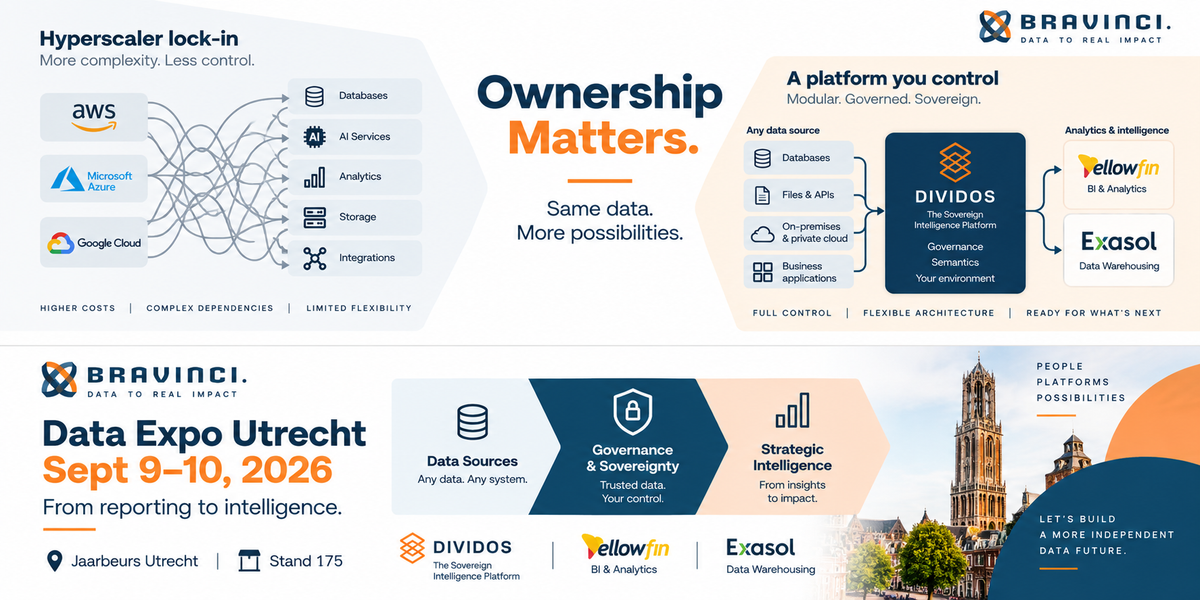
We're at Data Expo Utrecht this week. If you're thinking about data infrastructure—how to build it, run it, and own it—three posts from Bravinci (where I'm a Consulting Partner) cut to the heart of what's actually changing.
They're not about dashboards. They're about how the best organizations have stopped accepting that they need to stay locked into hyperscaler economics just to have a data platform.
The Three Posts (and what they really mean)
First: Eight Reasons Beyond Hyperscaler Lock-In
The premise is simple: cloud lock-in can become expensive. The question is how much of that dependency you actually need. Once you start using a hyperscaler's services (the databases, the data warehouses, the AI tools), you end up building your entire stack around their choices. Switching costs can rise quickly. Pricing and commercial terms can change over time. And, most importantly, your data residency options can become constrained by what the hyperscaler supports, rather than being driven solely by what your business needs.
We walk through eight specific ways lock-in costs you: in velocity, because you're constrained by their roadmap; in cost, because you're captive; in governance, because compliance is harder when data is spread across that vendor's global infrastructure. Most critically: you've surrendered control over where your intelligence lives.
For mid-market organizations, this matters. You're not a startup that can relocate to cheaper compute. You're not a megacorp with a team negotiating contracts. You're in the middle, needing predictable costs, local data sovereignty for compliance, and the ability to choose your tools instead of having them chosen for you.
Second: How Dividos Actually Works
The second post shows how three organizations (different industries, different sizes) use the same platform to go from raw data to strategic intelligence. The architecture is modular. You choose your data source. Any source. You connect it to a semantic layer that governs what data means. Then you layer analytics on top. The details shift by use case, but the principles stay consistent.
What matters here: there's no hidden dependency. You're not locked into our ecosystem. Dividos uses industry-standard components: Yellowfin for BI and Analytics, Exasol for Data Warehousing. Any piece can be swapped out. But they work together seamlessly because we thought about governance and semantics from the ground up.
The output isn't another dashboard. It's intelligence. Actionable signals about where the market is moving, what competitors are doing, what your own operations are telling you.
Third: Dividos Chose Sovereignty Over Convenience
The hardest post to write is the one where you defend a choice that's harder than the alternative. A conventional SaaS offering built on hyperscaler infrastructure could have been the easier route, with a simpler path to scaling.
Instead, we built Dividos to be deployable on-premises, in local clouds, in hybrid setups. The point: your data stays where you need it to stay. You control the hardware, the networking, the backups, the upgrades. You get security by design, not by hoping someone else's defaults align with your compliance requirements.
This can require more operational sophistication, but it gives organizations greater control over their architecture, deployment choices, and long-term dependencies. It's for organizations that have stopped treating data infrastructure as a commodity and started treating it as a competitive asset.
Why These Three Posts Tell One Story
Most organizations are still in reporting mode. They have a data warehouse. They have dashboards. They check KPIs on Friday afternoon. That's fine for knowing what happened. It's not enough for deciding what to do.
Moving from reporting to intelligence requires two things:
- The right architecture. Your platform needs to be modular (so you're not guessing what the vendor will build next), governed (so "data" means the same thing across teams), and transparent (so when something changes, you know why). That's Dividos.
- The right ownership model. If your data platform becomes deeply dependent on a hyperscaler's services and commercial model, future architecture and cost decisions can increasingly be shaped by that dependency rather than by your strategy. Sovereignty doesn't mean you avoid the cloud. It means you choose the cloud. You're not a tenant; you're an operator.
These three posts work together because they answer three questions:
- Why does lock-in matter? (Post 1)
- How does architecture that avoids lock-in actually work? (Post 2)
- Why is it worth choosing the harder path? (Post 3)
At Data Expo Utrecht
We'll be at the Bravinci stand alongside Yellowfin and Exasol from September 9–10 at Jaarbeurs Utrecht.
Come see Dividos in action. Not a marketing demo. An actual use case showing three organizations getting intelligence from their data without hyperscaler dependency. You'll see:
- How semantic layers turn raw data into decisions
- What governance that scales actually looks like
- Why modular architecture beats integrated lock-in
Bonus: Don't miss KNB's presentation, “How KNB is using AI without giving away control of their data,” on Wednesday, September 9, from 10:15–10:45 in Lecture Hall 7. This is exactly the sovereignty + intelligence story we're talking about. See the program.
Sound familiar? If you're flying blind on market signals, debating data quality instead of strategy, or spending too much time managing cloud costs and dependencies, that's exactly the transition we work on.
Through my work with Bravinci, I've seen how mid-market organizations approach this transformation. Projects that shift from "we have dashboards" to "we know what to do with what we know." From reporting mode to strategic intelligence. Dividos is the platform that makes that possible.
Stop by the Bravinci stand. We'll show you what sovereignty and governance look like in practice.
Read the Full Series
The three posts from Bravinci on Dividos are available here:
- Eight reasons smart organizations are moving beyond hyperscaler lock-in – Post 1
- How Dividos works: Three organizations. One platform. Strategic intelligence as the output. – Post 2
- Why Dividos decided to build for sovereignty, not convenience – Post 3
Cut through the noise. Build intelligence, not just dashboards.
Data Expo Utrecht, September 9–10, 2026
Jaarbeurs Utrecht
Bravinci stand 175
See you there.